Imagining Queer Utopia
From 26th of February to the 21st of June 2026
What if we allowed ourselves to feel life in all its intensity, even when it unsettles or disorients us?
The new exhibition at QUEER MUSEUM VIENNA envisions a utopia in which the human is understood not as the ruler of the world, but as a constantly transforming part of it. Hierarchies dissolve, relationships are in perpetual flux, and the self itself is always in motion. In this future world, desire and identity do not need to conform to categories. Instead, the exhibition calls on us to follow our desires without judgment.
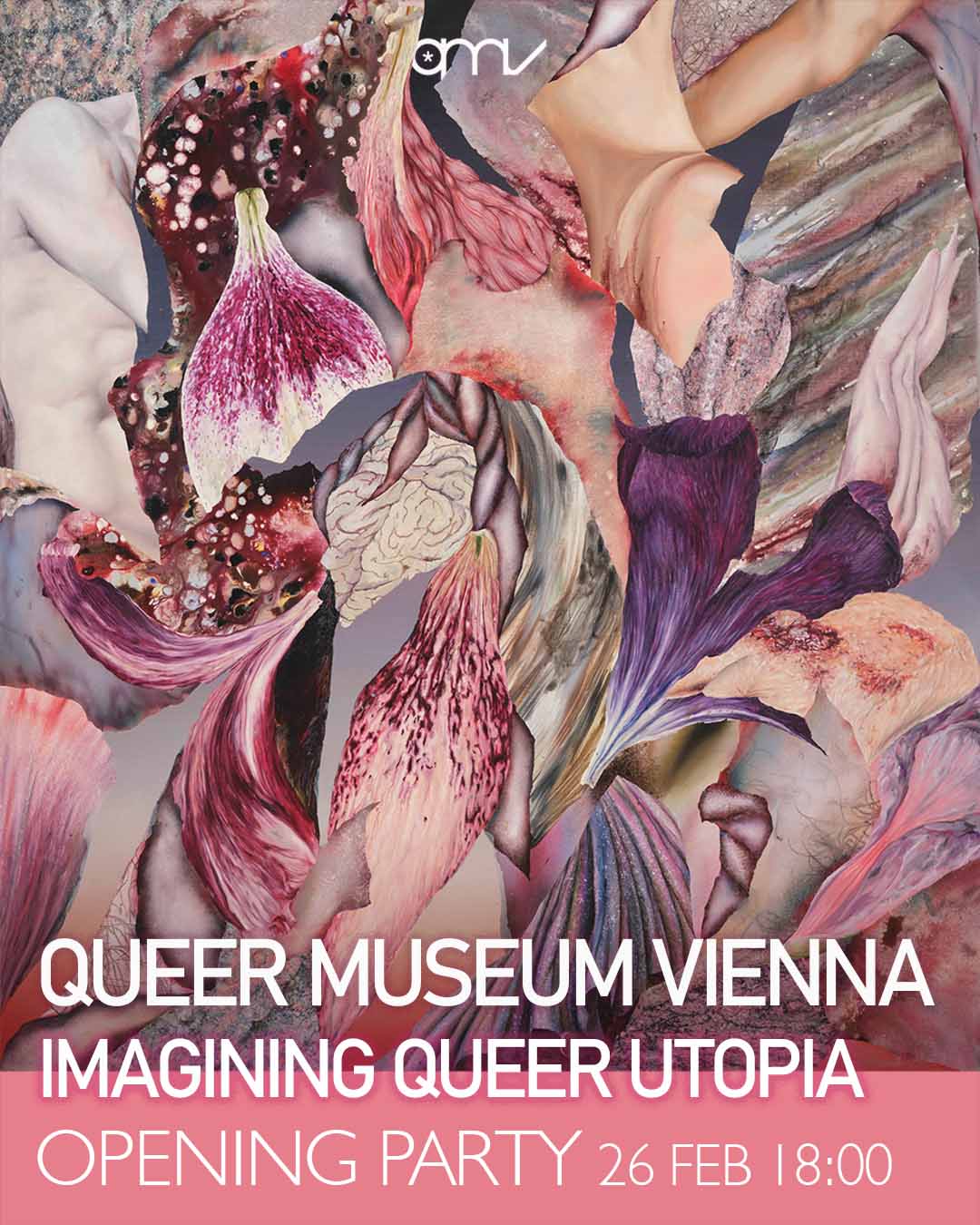
Large-scale textile works by the artist Zula Tuvshinbat depict wild, feminine, and divine figures that are seductive yet also threatening. Desire, fear, and tension are experienced simultaneously. Surreal paintings by Krzysztof Gil tell of hybrid beings, of sirens and mythological encounters, enabling a spectrum of voices and perspectives to coexist at once. Queer desire, which refuses to follow normative scripts, presents itself in all its diversity.
The exhibition’s curator, Michał Rutz, positions ecology in his utopia as intertwined with the mutable self. Humans and matter are unstable. They exist in multiple potential states. In the artworks, bodies, objects, and landscapes merge. They leave behind binary orders and egocentric narratives.
Liliana Zeic’s work engages with the organic world in all its complexity, from reproduction to care. The Colombian multidisciplinary artist Carlos Motta invites viewers into a contemplative video installation that leads back to the colonial era and its narrative of sin. The large-scale paintings by Paweł Matyszewski invite immersion in organic forms: compositions of blossoms, hair, tendrils, and bodies moving between beauty and disgust, between plants and intimacy. Similarly, materials and objects merge in Pille-Riin Jaik’s sculpture, distinguished by a materiality that tells its own story. Bartosz Kokosiński’s assemblages devour entire cities. The single-family home, an image of the established order of the nuclear family, is bent and twisted. New possibilities for communal life emerge from the destruction depicted.
Curated by Michał Rutz With Bartosz Kokosiński, Carlos Motta, Krzysztof Gil, Liliana Zeic, Paweł Matyszewski, Pille-Riin Jaik, Zula Tuvshinbat
Opening Hours: Thursday to Sunday 14-18:00
Otto Wagner Areal, C-Gebäude Baumgartner Höhe 1
www.queermuseumvienna.com
From Ego to Eco
This utopia has no center — no head, no authority.
Humans do not occupy a privileged position above the world; they are neither its rulers nor its measure. They exist as part of a collage of bodies, materials, and forces — entangled, interdependent, and constantly transforming through relations.
There is no separate, stable “self” — no pure culture, nation, race, or even organism as a closed whole. Even matter itself is unstable: existing in multiple potential states, constantly entangled, vibrating, and colliding. Humans are ecological assemblages, composed of trillions of microbes. Even our cells are hybrid — mitochondria were once independent bacteria. And this still barely scratches the surface of the forces that make us.
Becoming vs Being
If the self is never fixed, neither is desire. Desire — pre-subjective — flows freely through bodies, encounters, and social assemblages. It doesn’t need to settle into prescribed identities — man or woman, cis or trans, straight, gay, bi, ace, top or bottom, Black, Brown, White, and so on and so on. Claiming “I am X” can freeze desire, interrupting the flow of curiosity and possibilities. It risks replacing lived sensations with identity as obligation, subordinating the richness of actual experience to scripts and labels, turning life into duty instead of lived intensity. What if, instead of immediately naming or judging, we simply allowed desires to follow — letting life be felt fully, even when it disorients or unsettles us?
Against Regimes of Identity
Fascism and capitalism rely on identities shaped by consumption, competition, and belonging, rooted in binary oppositions — self/other, human/nature, male/female, inside/outside, nation/outsider. These predictable forms order, hierarchize, and discipline, constraining desire, narrowing imagination, and bending bodies to obey. Identity functions as a filter and a channel, capturing affect and desire, shaping them into socially acceptable forms while cutting off their surplus, intensity, and wildness.
Fluid Self and the Politics of Desire
In contrast, this utopian project invokes the fluid self and desire — relational, unstable, and always becoming. Queer desire becomes political because it refuses to be pinned down by static identities, normative scripts, productivity regimes, or utilitarian logics. It overflows, drips, leaks, and squirts across boundaries, contaminating, smearing, and soiling the fascist fantasy of purity — seeping into messy, wild, and unpredictable ways of living, loving, and relating.
The works in this exhibition embody that excess. Bodies, objects, and landscapes merge, mutate, and spill into one another, forming hybrid amalgams that escape binaries and ego-driven narratives. What unfolds is a tableau of queer eco-mythology populated by oddly formed beasts, anomalies, and outcasts. Breaking with anthropocentric logic, they invite us to unlearn, drift, and unbuild the structures of oppression. Prepare to be bewildered, cruising with wild things that resist containment and rewrite the imaginable.
Many thanks to the supporters of this exhibition:
All our private donors
and especially to